

Density Coaster Design - STEAM Lesson
STEAM activities use hands-on learning—like building, experimenting, and exploring—to boost critical thinking and creativity. For children and siblings facing pediatric cancer, these activities are more than just schoolwork; they bring back a feeling of normalcy, success, and confidence during a difficult time.
STEAM education helps kids learn vital skills, connect with others, and have fun! These at-home STEAM activities let children and siblings facing pediatric cancer explore Science, Technology, Engineering, Art, and Math in a fun, comfortable setting.
Age Group Best Served: K-8
Child/Adult Ratio: 6 to 1
Take Away Artifact: No
Approximate time: 1 hour
Divisions Covered: All
Materials:
8-10 Different Balls: Approximately 1”-2” (Golf, Steel, Ping Pong, Wooden, Gum, Bouncy, Wiffle, Styrofoam, Small Tennis), PVC pipe, gutter sections, landscaping pipe, wooden trim, birdseed bags, 2 x 4 blocks cardboard tubes, cardboard boxes, masking tape, and a stopwatch
Questions to ask:
What is density? What is texture? What is friction? How do these characteristics affect movement?
Skills Required for Completion of Task:
Motor skills
- Bilateral upper extremity coordination
- Ability to manipulate small objects
- Hand-eye coordination
- Ability to grip objects
- Ability to stabilize objects/task
Process/Cognitive skills
- Ability to attend to task for greater than 5 minutes
- Follow multi-step directions
- Ability to sequence steps
- Ability to understand safety precaution
- Ability to organize or keep materials organized for task
- Ability to adjust to different workspace requirements
Social skills
- Ability to communicate and share equipment with peers/staff appropriately
K-8 Standards:
5.PS2: Motion and Stability: Forces and Interactions 1) Test the effects of balanced and unbalanced forces on the speed and direction of motion of objects. 2) Make observations and measurements of an object’s motion to provide evidence that a pattern can be used to predict future motion. 3) Use evidence to support that the gravitational force exerted by Earth on objects is directed toward the Earth’s center. 4) Explain the cause and effect relationship of two factors (mass and distance) that affect gravity.
This activity would be appropriate completed by the following disciplines:
Occupational Therapy, LCSW, Family Services, Industrial Art
Instructions:
Students will each be given a bag of balls. They will mark the balls with a colored dot for identification. Students will play and interact with one ball at a time. Students will use a stopwatch to time each ball traveling through the course. The group will then come together and complete the following spreadsheet as group (using volunteers)
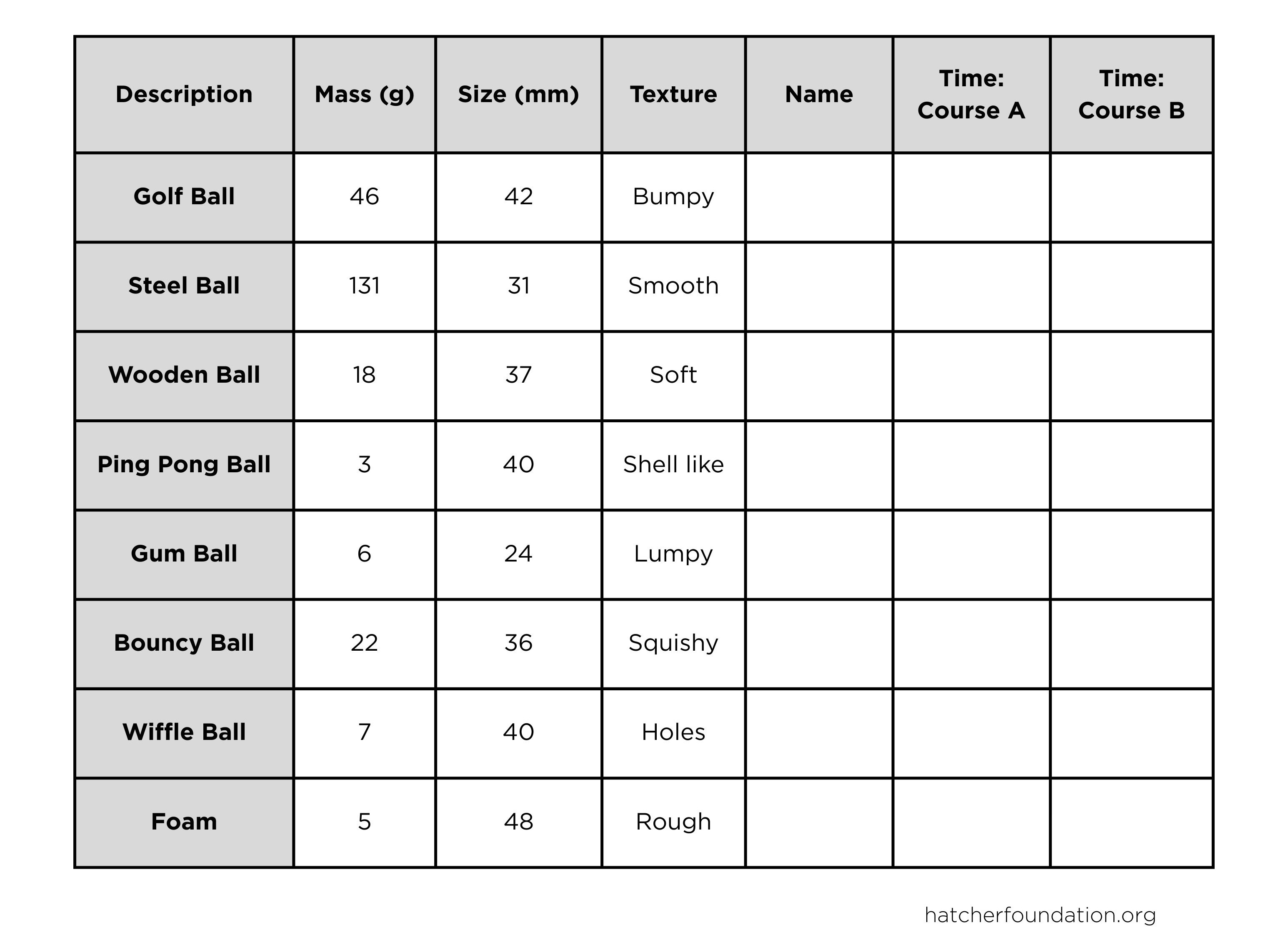
In two groups, students will then design a course to test the speed of the balls rolling through the course.

The Austin Hatcher Foundation is a nationally recognized leader in psycho-oncology care, providing innovative, evidence-based services for families facing pediatric cancer. Through a holistic approach, the Foundation supports the emotional, mental, and social well-being of children, siblings, and parents—ensuring families have the resources to heal and thrive during and after treatment.
Through programs like STEAM Club and at-home resources like these, we encourage creativity, build confidence, and strengthen connections through hands-on learning. To learn more about our programs or to request comprehensive support, visit https://www.hatcherfoundation.org/resources/request-an-appointment


.png)